Greenland replaces its entire energy meter fleet with smart meters and a radio based remote reading system
Until 2012 the supply company Nukissiorfiit replaces all energy meters in Greenland with smart meters and a radio based automatic meter reading system. The project comprises 43,000 metering points in a combined system for electricity, water, and heat consumption.
The supply company expects the remote reading system to become an important instrument for an improved customer service and considerable energy reductions.
The project is unique. For the first time a single automated reading system will handle consumption data of an entire country.
The main part of the meters – 34,000 – are electricity meters, because most blocks of flats in Greenland have common heat and water metering.
The supply company Nukissiorfiit has great expectations of the radio based remote reading system, seeing perspectives in terms of improved customer consulting and reduced energy consumption. Meters and system solution are delivered by Kamstrup A/S who have specialized in radio based automatic reading systems.
Conquering nature
With only 56,000 inhabitants spread out over the world’s biggest island of which 85% is permanently covered by ice, Greenland presents a very interesting case with regard to the advantages of radio based automatic meter reading. All intercity transportation in Greenland must take place by air or by sea. But in the case of transporting data the human element can be completely dispensed with.
Because of the climatic and geographic challenges and because of the often non-existing infrastructure, remote reading via radio technology is a natural, simple and economically viable solution. The so far practised manual reading, where a person from the supply company must be physically present is – for obvious reasons – extremely costly. The small villages in Greenland lie far apart and are not connected by roads.
Sisimiut, second largest city in Greenland
As a result of the overwhelming distances the supply company explicitly demanded the disconnect-feature that enables a remote power cut of a single installation, for instance an uninhabited house.
Two-way communication is no extravagant feature in a country like Greenland, quite the contrary: it is a crucial prerequisite in overcoming the natural challenges.
Reliable system
Nukissiorfiit sought a technically stable, economic and flexible solution.
The meters are connected to a radio network of 200-300 units transmitting to a shared concentrator. The concentrator itself transmits via the GSM net to the supply company. The wireless connection ensures a data transmission independent of the powerline grid and a direct communication with the individual meter. Radio communication is thus unaffected by possible disturbances and outages in the powerline grid.
An extremely high system security is
attained by the fact that every meter
functions as a radio router as well for up
to 70 other meters. Each meter is
thereby reachable through multiple
routes. Solitary meters outside the
system are provided with their own SIM
card and transmit data via GSM directly
to the supply company.
Mounting a radio router
For collecting and managing meter data Nukissiorfiit uses the EMS10-system by Kamstrup. This system is especially designed for reading a large number of household meters in a radio network and some consumers transmitting via GSM. The EMS10-software is developed by Kamstrup’s Norwegian subsidiary company.
A pilot project north of the polar circle ushered in a future with energy reductions
A pilot project was carried out in the spring of 2007 in Sarfannguaq, a village 40km north of the polar circle. Two concentrators collected data and transmit them to the central server 3400km away.
From the pilot project valuable experiences were gathered and are now being spread to the rest of the country. The first intermediate aim is the replacement of all energy meters in Nuuk by 2008.
In May 2008 the project managers Peter Kjeldmann and Kent Skildal from Nukissiorfiit presented the pilot project and its perspectives on a smart metering conference in Barcelona. The interested and positive reactions convinced them that the project is innovative and futurist.
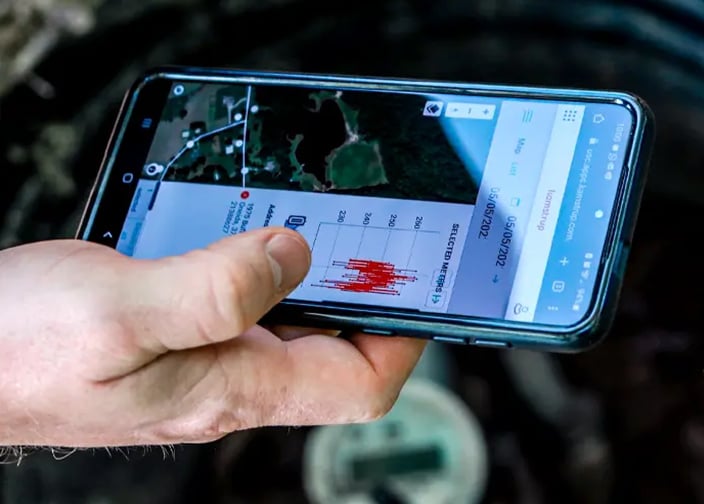
Project manager Peter Kjeldmann has especially high expectations of the energy saving perspectives provided by the new meters and the new system. At the time of the pilot project, he was able to demonstrate the system to a group of pupils by collecting data directly from each pupil’s home. The end users were able to log on to the system themselves and read the real-time data of their electricity consumption – which was updated every hour.
Readings from one day after the implementation of automatic meter reading
Readings from three years before the implementation of automatic meter reading
An increased awareness of energy consumption is an essential pre-condition for energy savings in the private household. The means to provide this awareness is an explicit, frequent and precise measuring of the energy consumption.
This far more concreted and visible communication of the consumption is one of the great advantages of the automatic meter reading system. The individual consumer now faces his consumption directly on the electricity bill as opposed to paying on account.
The meters actually take over the function of the cash register in the supermarket meaning that the energy taken from the power grid is instantly accounted for.
The new system provides the supply company with an immediate picture of the energy consumption which enables it to offer a significantly enhanced service being able to survey the consumption of a single household. Until now the company simply accounted for the used energy, but will now take advantage of the newly gained features and inform single households in case of particularly large movements or an otherwise extraordinary consumption pattern. It will now be possible to take action against installations where inappropriate consumption has been high-lighted.
The rough nature of Greenland is no hindrance for a secure meter reading. The frequent hourly readings are also used to register details in power outages. During the pilot project in the village Sarfannguaq a supply security of 99,992% was registered (in total 34 minutes outage in a period of 10 months).
Securing optimal documentation is necessary in order to plan new energy saving actions. For the supply company the enhanced data collection means a strongly improved basis for decisions when, in future, a more sustainable energy production based on renewable energy sources will be introduced. Access to precise meter data is a pre-condition for planning future installations.
Readings of consumption data over two weeks from a private household after the implementation of automatic meter reading
It is only natural that Greenland is now focusing on energy savings. Greenland is first and foremost affected by the climate change. Despite this visible change in nature it takes, though, a change in mentality. This is why the private consumption must be manifestly coupled with a noticeable cost for the consumer. The link between private consumption and private economy is after all more tangible than the connection between consumption and climate change.
With this initiative Greenland will now be frontrunner in the global effort to reduce the private energy consumption.
| Facts |
| 43,000 metering points |
| Combined system of heat, water, and electricity |
| Smart metering system: Radio Mesh Network with EMS10-software |
| Electricity meters: Kamstrup 382E with integrated radio module and disconnect function |
| Water meters: Kamstrup MULTICAL 41 with radio module |
| Concentrator station: GSM/GPRS-concentrators |
| Data from electricity meters are automatically collected every hour |
| Time frame: 2007-2012 |
| About Nukissiorfiit |
| Supplies entire Greenland with electricity, heat and water |
| In charge of planning, building, operating, and maintaining all power and water works |
| Totally 109 electricity works (including transportable and emergency works), 40 heat utilities, 20 water works and 49 water supply facilities |